Jet Card vs Charter vs Empty Leg: Which Is Cheapest?
There are three common ways to fly private from New York without owning a jet: book a charter trip by trip, prepay for a jet card, or catch an empty leg. Each is priced differently, and the cheapest one depends less on the jet than on how often and how flexibly you fly.
The three options at a glance
- Per jetAll three are priced per aircraft, not per seat: one passenger or six pay the same for the same jet.
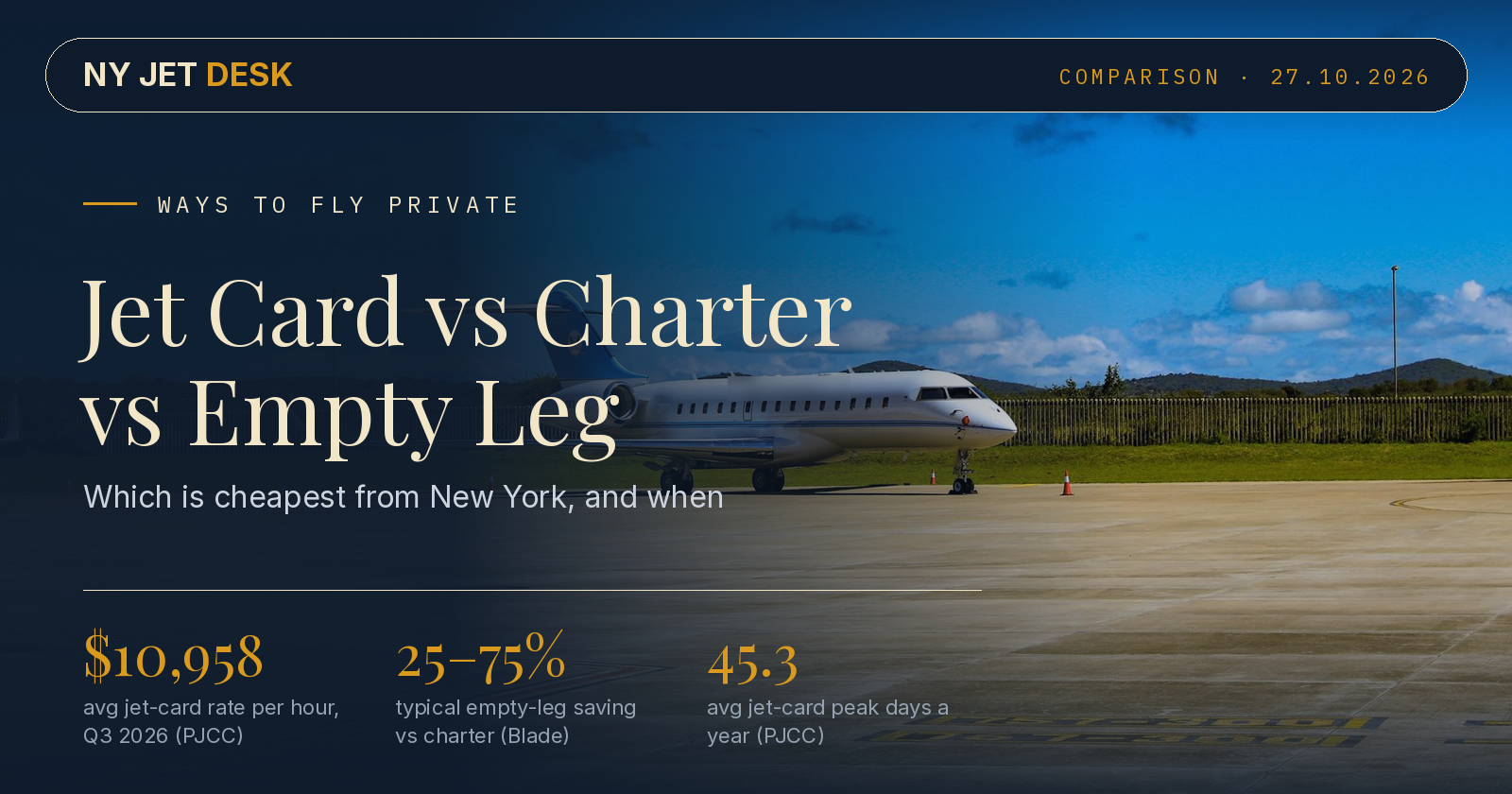
- $10,958Average published jet-card rate per hour across all jet sizes in Q3 2026, including fuel and 7.5% federal excise tax (Private Jet Card Comparisons).
- $25k–$1MRange of jet-card deposits; buyers typically fly 15 to 50 hours a year (Private Jet Card Comparisons).
- 25–75%Typical empty-leg saving versus a standard charter, with fixed routes and times and booking windows that can be under 48 hours (Blade).
The short answer
For a single trip on your own schedule, on-demand charter is the default: you get a quote, you pay for that trip, and you commit to nothing else. If you fly often, especially on busy dates, a jet card buys you a fixed hourly rate and guaranteed availability, paid in advance. If your dates and route are flexible, an empty leg is usually the lowest price for a given jet, because the aircraft was going to fly that route anyway.
So “cheapest” has two parts: the price of the hour, and the price of the conditions attached to it. The rest of this guide compares both. For the bigger picture of flying private from the city, see our New York private-jet guide.
Side by side
| On-demand charter | Jet card | Empty leg | |
|---|---|---|---|
| How you pay | Per trip, from a quote | Prepaid deposit or hour block, then flights deducted | Per flight, one way |
| Price certainty | Market price on the day | Fixed hourly rate (fixed-rate programs) | Discounted, set by the operator |
| Availability | Whatever is free | Guaranteed, with notice rules | Only when a jet repositions |
| Your schedule | Yours | Yours, within callout and peak-day rules | The jet's |
| Commitment | None beyond the trip | $25,000 to $1,000,000 up front | None beyond the flight |
| Main catch | Prices rise on busy dates | Daily minimums, peak days, refund rules | Can be cancelled if the original trip changes |
Jet-card terms: Private Jet Card Comparisons. Empty-leg terms: Blade. Charter pricing: Blade price guide.
On-demand charter: pay per trip
With on-demand charter you ask for a quote for your route, date and group, and an operator prices the whole aircraft for that trip. Nothing is prepaid and nothing carries over. That makes it the most flexible option and the easiest to start with, but the price follows the market: on a busy holiday weekend it can be far higher than on a quiet Tuesday.
A charter quote is built from several parts. Blade's price guide says operators bill flight time, often with a minimum charge of about two flight hours; that a positioning flight, if the jet has to come from elsewhere, is billed to the client; and that taxes, fuel surcharges, landing fees and crew costs can add 20–40% to the base rate. Domestic charters also carry the 7.5% federal excise tax and a $5.30 segment fee per passenger in 2026, according to the FAA. Our guide to private-jet pricing breaks this down in detail.
Jet cards averaged $10,958 an hour in Q3 2026
That is the published average across all jet sizes, with fuel and the 7.5% federal excise tax (Private Jet Card Comparisons), and it needs a deposit of $25k or more. Get a live charter estimate for your own route and compare, with no deposit.
Jet cards: prepay for a fixed hourly rate
A jet card is a prepaid private-flying program. Private Jet Card Comparisons, which tracks more than 80 providers, describes it as a debit-card-style program: you deposit money or buy a block of hours, such as 25 hours or $150,000, and then book at a contracted hourly rate with guaranteed availability. Deposits range from $25,000 to $1,000,000. Some programs fix the rate; others use dynamic pricing and requote each flight at market rates, so check which kind you are buying.

The headline rate is only part of the cost. In the third quarter of 2026, Private Jet Card Comparisons found that the average rate fell 3.1% on the quarter to $10,958 an hour, but that daily minimums rose to an average of 95 minutes. A daily minimum means a short flight is billed as if it were longer, which hits New York flyers on short hops to Boston or Washington harder than on a Florida trip. The same analysis counted an average of 45.3 peak days per program, up from 36.5 a year earlier, and an average non-peak callout (the notice you must give before a flight) of 64.8 hours.
A jet card mainly sells certainty: a known rate and a guaranteed jet. That certainty is worth most on the dates when charter is hardest to find, but those are also the dates most programs mark as peak days with stricter terms. Read the peak-day calendar before you compare rates.
Unused money is the other detail to check. Private Jet Card Comparisons notes that some providers refund unused funds, some let you roll them into a new program and some are non-refundable, sometimes with a service fee for refunds. It also says jet-card buyers typically fly 15 to 50 hours a year. Below that, the deposit sits idle for long stretches.
Empty legs: the discount with conditions
An empty leg is a repositioning flight: a jet that has to fly somewhere without passengers, sold at a reduced price. Blade puts the typical saving at 25–75% versus a standard charter. The price is low because the operator's costs are already covered by the original trip, and the catch follows from the same fact: the route, date and time are the jet's, not yours. Blade notes booking windows that can be under 48 hours, and an empty leg can change or disappear if the original charter is moved or cancelled.
From New York, empty legs often appear on routes that are busy in one direction, such as returns from Florida in winter. Our guides explain what an empty-leg flight is and how to find empty legs from New York.
Which is cheapest for you?
There is no single winner, so here is how the three compare for common New York situations. These are rules of thumb based on how each option is priced, not quotes.
| Your situation | Usually the best fit | Why |
|---|---|---|
| One or two trips a year, fixed dates | On-demand charter | No deposit, pay only for the trip |
| Flexible dates, one-way trip | Empty leg | Lowest price for a given jet if a leg matches |
| Around 15–50 hours a year | Compare a jet card with charter | The range where card buyers typically fall |
| Must fly on holidays at short notice | Jet card (check peak days) | Guaranteed availability at a contracted rate |
| Many short hops (under an hour) | Check daily minimums | Minimums can make short card flights expensive |
Whichever way you lean, compare like with like. Jet-card rates published by Private Jet Card Comparisons already include fuel and the federal excise tax, while a charter quote's base rate may not. Ask for an all-in charter price before you set it against a card rate, and remember that every option is priced per jet, so a larger group splits the same price more ways. Choosing the right size of aircraft matters as much as the buying model; our light vs midsize vs heavy jet guide helps with that.
A note on the holidays
The difference between the three options is sharpest from Thanksgiving to New Year. On-demand charter is hardest to find and most expensive then; jet cards guarantee a jet but usually treat those weeks as peak days; and empty legs appear mainly on return legs after the rush south. Our holiday booking guide covers the 2026 dates and lead times.
How this guide was built
Jet-card rates, daily minimums, peak days and callouts are from Private Jet Card Comparisons' Q3 2026 pricing analysis, which covers published rates from more than 80 providers and includes fuel and 7.5% federal excise tax. Jet-card deposits, structure and typical usage are from the same site's jet-card FAQ. Charter cost components are from Blade's price guide, and the excise tax and segment fee from the FAA. Empty-leg savings and terms are from Blade. The “which option fits” table is our own guidance based on these pricing rules; it contains no prices of its own. We did not invent or estimate any figures.
Sources
- Jet Card prices fall 3.1% in Q3 — Private Jet Card Comparisons (hourly rates by category, daily minimums, 45.3 peak days, 64.8-hour non-peak callout).
- Frequently Asked Questions about Jet Cards — Private Jet Card Comparisons (definition, $25,000–$1,000,000 deposits, refund rules, 15–50 hours a year).
- Private Jet Cost: How Much Does It Cost to Fly Private? — Blade (minimum charges, positioning, 20–40% in taxes and fees).
- Current Aviation Excise Tax Structure and Rates 2026 — FAA (7.5% tax, $5.30 segment fee).
- Empty Leg Flights — Blade (25–75% savings, fixed routes and times, short booking windows, cancellation risk).
Retrieved October 2026. Jet-card figures are averages of published program rates, not quotes; charter and empty-leg figures are broker estimates. Real prices come from a live quote.
Frequently asked questions
Is a jet card cheaper than chartering a private jet?
Not automatically. A jet card fixes an hourly rate in advance, which protects you when charter prices spike, for example over the holidays. On-demand charter is quoted trip by trip and can be cheaper or more expensive on any given day. Compare all-in prices: Private Jet Card Comparisons says its jet-card rates include fuel and the 7.5% federal excise tax, while Blade's price guide says taxes and fees can add 20–40% to a charter's base rate.
How do jet card hours work?
You prepay, either a dollar amount or a block of hours such as 25 hours, and each flight is deducted at the contracted hourly rate. Most programs also charge a daily minimum: Private Jet Card Comparisons put the average at 95 minutes in the third quarter of 2026, so a 45-minute hop is billed as a longer flight.
How much do you have to deposit for a jet card?
According to Private Jet Card Comparisons, jet-card deposits range from $25,000 to $1,000,000, sold in dollar amounts or hour blocks. Refund rules for unused funds differ by provider, and some programs are non-refundable.
Are empty legs always the cheapest option?
They are usually the cheapest way to fly a given jet one way, with Blade reporting savings of 25–75% against a standard charter. But the route and time are set by the operator, booking windows can be under 48 hours, and the flight can be cancelled if the original charter changes. They only suit flexible plans.
Who should buy a jet card?
Private Jet Card Comparisons says jet-card buyers typically fly 15 to 50 hours a year. If you fly only a few trips, on-demand charter plus the occasional empty leg is usually the simpler choice; if you fly often and need guaranteed availability on fixed terms, a card starts to make sense.
What are peak days on a jet card?
Days when the program applies stricter terms, such as longer notice, longer cancellation deadlines or a surcharge. Private Jet Card Comparisons counted an average of 45.3 peak days per program in the third quarter of 2026, and the Thanksgiving and Christmas weeks are typically among them.
Compare with a real price
Get a free live estimate for your next trip from New York, or browse the empty legs on offer right now. No obligation.
Part of the NY Jet Desk guides — data and route guides for flying private from New York.