Light vs Midsize vs Heavy Jet: Which for New York to Florida?
New York to Florida is about 1,000 miles and under three hours in the air, so every jet category can fly it non-stop. The choice is really about headroom, seats and luggage, not speed. Here is what the manufacturers’ own figures say for one typical aircraft in each class, and how to pick.
Jet categories at a glance
- ~900 nmTeterboro to Palm Beach is about 1,036 miles, roughly 900 nautical miles (Air Miles Calculator). Every category below has at least twice that range.
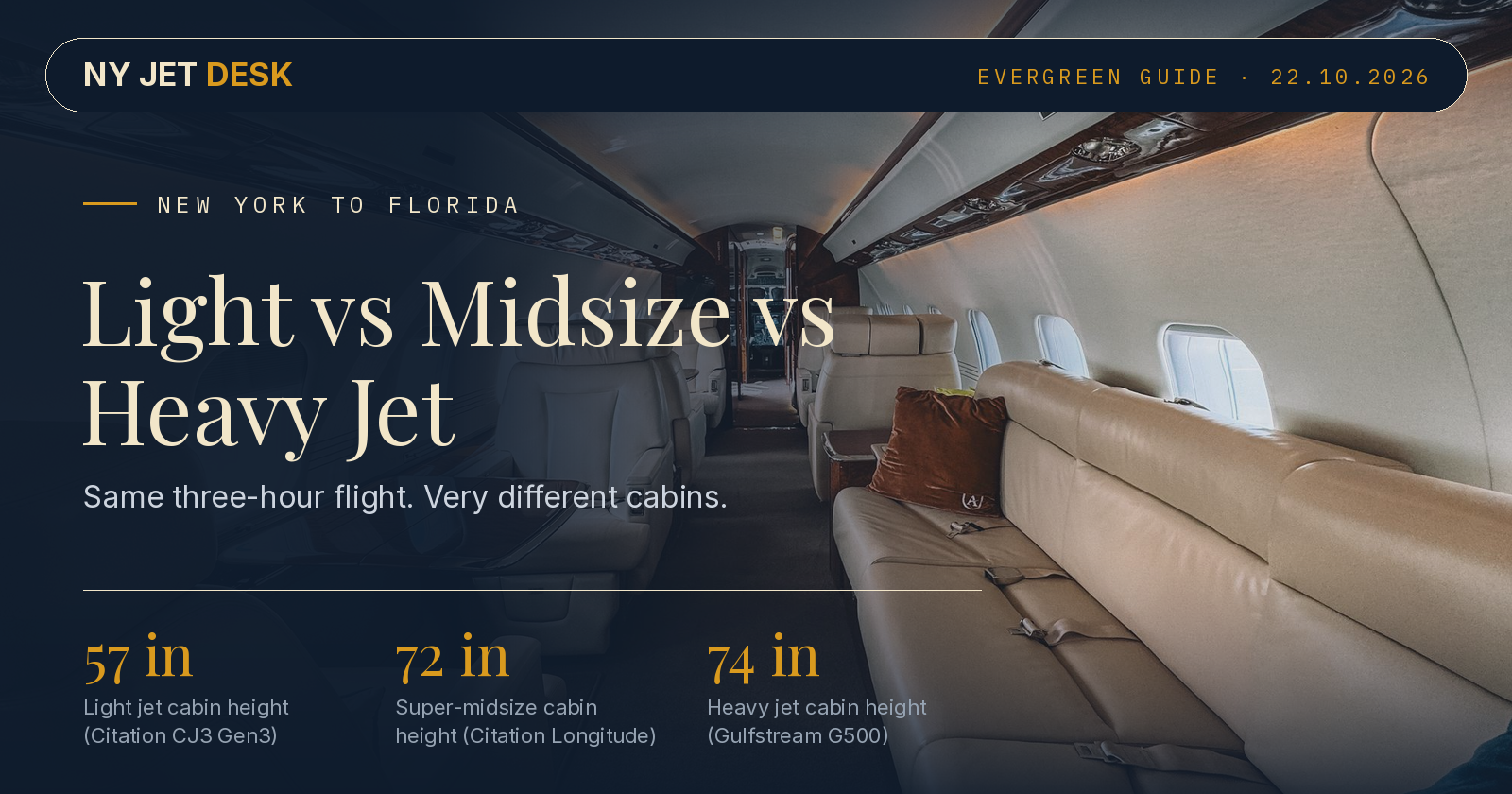
- 57 incabin height of the Citation CJ3 Gen3, a light jet, with 65 cu ft of baggage space (Textron Aviation).
- 60 incabin height of the Citation Ascend, a midsize jet, with 90 cu ft of baggage space (Textron Aviation).
- 72 instand-up cabin of the Citation Longitude, a super-midsize jet, with 112 cu ft of baggage (Textron Aviation).
- 74 incabin height of the Gulfstream G500, a heavy jet, with 175 cu ft of baggage and up to 19 seats (Gulfstream).
- ~30 minis all the flight time a large jet saves over a light jet on Teterboro to Palm Beach, by broker estimate (Executive Charter).
The short version
On a 1,000-mile route the category barely changes the flight time, but it changes the cabin a lot. Pick by how many people fly, how much luggage they bring and whether anyone needs to stand up. For one to four travellers with normal bags, a light jet does the job; eight people with golf clubs point to a super-midsize or heavy jet.
What the categories mean
“Light”, “midsize”, “super-midsize” and “heavy” are industry habits, not regulatory classes, and brokers draw the lines slightly differently. Stratos Jets, a charter broker, uses typical figures of 4–7 passengers and a 1,000–2,000-nautical-mile range for light jets, 6–9 passengers and 1,750–3,000 nm for midsize, 8–12 passengers and 2,000–4,200 nm for super-midsize, and 10–16 passengers and 3,500–5,500+ nm for heavy jets. The same guide notes that light jets have limited headroom and baggage space and are rarely suited to coast-to-coast non-stop flights, and that heavy jets “can be more aircraft than a shorter trip needs”.
Those are typical ranges. To make the comparison concrete, the table below uses one current production aircraft per class with the figures its manufacturer publishes. Other jets in the same class differ, and the seats actually installed on a charter aircraft are often fewer than the manufacturer’s maximum, so treat these as orientation, not a promise about the jet you will be assigned.
One example aircraft per class
| Class | Example | Cabin height × width | Baggage | Range | Max seats |
|---|---|---|---|---|---|
| Light | Citation CJ3 Gen3 | 57 × 58 in | 65 cu ft | 2,040 nm | 9 |
| Midsize | Citation Ascend | 60 × 66 in | 90 cu ft | 1,940 nm* | 12 |
| Super-midsize | Citation Longitude | 72 × 77 in | 112 cu ft | 3,500 nm | 12 |
| Heavy | Gulfstream G500 | 74 × 91 in | 175 cu ft | 5,300 nm | 19 |
Sources: Textron Aviation product pages for the Citation CJ3 Gen3, Citation Ascend and Citation Longitude; Gulfstream product page for the G500 (cabin 6 ft 2 in by 7 ft 7 in). *Ascend range is Textron’s figure with four passengers. Maximum seats are manufacturer figures and count all occupants on some types; charter configurations are usually smaller. Retrieved October 2026.
Headroom: the number that changes the experience
Cabin height is the figure most people notice first. At 57 inches, the CJ3 Gen3 cabin is one you move through bent over; that is normal for a light jet and fine for a three-hour flight, but it is not a cabin to stand in. The Ascend adds three inches, or eleven with Textron’s optional taller cabin. The Longitude and the G500 are true stand-up cabins at 72 and 74 inches, and the G500 is also more than two and a half feet wider than the CJ3 Gen3. If anyone in the group is tall, or you expect to work, eat or move around on board, that is where the extra money goes.
Baggage: from four suitcases to a hold
Baggage space grows faster than seat count. The CJ3 Gen3 carries 65 cubic feet, the Ascend 90, the Longitude 112 and the G500 175. For a couple with two suitcases any of these is plenty. For six people with golf bags, or a family with skis and strollers, the light-jet hold fills up fast, and weight limits can bite before the space does. Our guide to flying private with pets, skis and extra luggage goes into the practical questions to ask.
A bigger jet saves only about 30 minutes to Palm Beach
On Teterboro to Palm Beach a large jet is about half an hour faster than a light jet (Executive Charter, broker estimate). Pay for a bigger cabin for people and luggage, not for speed. Compare a light and a midsize estimate for your dates side by side.
Range and flight time: why speed is not the deciding factor
Teterboro to Palm Beach is about 1,036 miles by great-circle distance (Air Miles Calculator), which is roughly 900 nautical miles. Even the shortest-legged example above, the Citation Ascend, lists almost twice that, so no category needs a fuel stop on a New York to Florida run under normal conditions. Headwinds, a full cabin or a diversion to another airport change the numbers, and your operator plans for that, but range is not what separates the classes on this route.
Neither is speed, really. Executive Charter, a charter broker, estimates about 2 hours 45 minutes for a light jet, 2 hours 30 minutes for a midsize, 2 hours 20 minutes for a super-midsize and 2 hours 15 minutes for a large jet on Teterboro to Palm Beach. Those are broker estimates rather than audited block times, but the pattern holds: the largest jet saves about half an hour over the smallest. Our Teterboro to Palm Beach guide and Teterboro to Miami guide show the same picture for each route.
Count the people and the bags, then decide whether anyone needs to stand. Only then look at flight time, because on this route it will not change your decision.
The Teterboro weight limit
One New York detail matters for the biggest jets. Teterboro has a 100,000-pound aircraft weight limit, which is why it has no airline service (Wikipedia). Most heavy jets sit comfortably under it, but the largest ultra-long-range aircraft do not: Gulfstream lists a maximum takeoff weight of 105,600 pounds for its G800, for example. In practice that means a heavy jet for a Florida trip is a Challenger- or G500-class aircraft rather than the very largest types, or the flight uses Westchester County (HPN) instead. Your operator handles this; it is simply worth knowing why a quote may name a different airport. The New York private-jet hub guide covers both airports.
Which class for which trip
A practical guide
- One to four people, normal luggage, under three hours: a light jet. It is the most common and usually the most economical whole-jet option on this route.
- Five to seven people, or a few bulky bags: a midsize jet. More headroom and roughly 40 per cent more baggage space than the light-jet example above.
- Six to nine people who want to stand up, or a lot of gear: a super-midsize jet. A real stand-up cabin and the biggest jump in comfort for the money on a domestic flight.
- Ten or more, or a trip that continues abroad: a heavy jet. The largest cabin, the longest range and the most baggage, but check the Teterboro weight limit with your operator.
Price follows size as a rule, because the whole aircraft is priced, not the seat, and bigger aircraft cost more to operate. But the price for your dates depends on which jets are available near New York that day as much as on category, which is why we do not print prices here. Our guide How Much Does a Private Jet Cost? explains the whole-jet model, and if your dates are flexible an empty-leg flight in a larger jet can sometimes cost less than a standard charter in a smaller one.
How this guide was built
Cabin dimensions, baggage volumes, ranges and seat maximums come from the manufacturers’ own product pages: Textron Aviation for the Citation CJ3 Gen3, Citation Ascend and Citation Longitude, and Gulfstream for the G500 and the G800 weight figure. Category definitions and typical passenger ranges come from a Stratos Jets broker guide, and flight-time estimates for Teterboro to Palm Beach from Executive Charter’s route page; both are broker estimates, not audited figures. The route distance is from Air Miles Calculator and the Teterboro weight limit from Wikipedia. The “which class for which trip” guide is our reading of those figures, not a cited rule. We do not state charter prices because they change with date and demand; live prices on NY Jet Desk are provided by Villiers.
Sources
- Citation CJ3 Gen3 — Textron Aviation (cabin, baggage, range, seats).
- Citation Ascend — Textron Aviation (cabin, baggage, range, seats).
- Citation Longitude — Textron Aviation (cabin, baggage, range, seats).
- Gulfstream G500 — Gulfstream (cabin, baggage, range, seats).
- Gulfstream G800 — Gulfstream (maximum takeoff weight).
- Light Jet vs Midsize vs Super-Midsize vs Heavy Jet — Stratos Jets (category definitions, typical passengers and range).
- Teterboro to West Palm Beach Private Jet Charter — Executive Charter (flight times by category).
- Teterboro to West Palm Beach Flight Time — Air Miles Calculator (distance).
- Teterboro Airport — Wikipedia (weight limit).
Retrieved October 2026. Manufacturer figures describe current production aircraft; charter aircraft may be older or configured differently. Broker figures are estimates.
Frequently asked questions
Is a light jet big enough for New York to Florida?
For most trips, yes. Teterboro to Palm Beach is about 1,036 miles, or roughly 900 nautical miles, and Textron lists a 2,040-nautical-mile range for the Citation CJ3 Gen3, a typical light jet. Brokers' estimates put a light jet at about 2 hours 45 minutes on the route, only around 30 minutes slower than a large jet. The limit is the cabin: 57 inches of headroom on the CJ3 Gen3 and about four suitcases of baggage space, so it suits small groups with normal luggage.
What is the difference between a midsize and a super-midsize jet?
Mainly cabin size and range. Textron's Citation Ascend (midsize) has a 60-inch cabin height, 66-inch width and 90 cubic feet of baggage space; its Citation Longitude (super-midsize) has a 72-inch stand-up cabin, 77-inch width and 112 cubic feet of baggage. Both fly New York to Florida non-stop; the Longitude's 3,500-nautical-mile range is far more than the route needs.
Does a heavy jet get to Florida much faster?
Not much. Executive Charter's broker estimates for Teterboro to Palm Beach run from about 2 hours 45 minutes in a light jet to about 2 hours 15 minutes in a large jet, a difference of roughly half an hour. Heavy jets earn their keep on long flights and with big groups, not on a three-hour hop.
How many passengers fit in each jet category?
Stratos Jets, a charter broker, gives typical figures of 4 to 7 passengers in a light jet, 6 to 9 in a midsize, 8 to 12 in a super-midsize and 10 to 16 in a heavy jet. Manufacturer maximums are often higher than the seats actually installed on a charter aircraft, so confirm the seat count of the exact jet you are quoted.
Can every heavy jet use Teterboro?
Not every one. Teterboro has a 100,000-pound aircraft weight limit (Wikipedia). Gulfstream lists a maximum takeoff weight of 105,600 pounds for its G800, so the very largest ultra-long-range jets are above the limit, while a G500-class heavy jet is well within it. Your operator checks this for you, and Westchester County is the usual alternative.
Does a bigger jet always cost more?
As a rule, yes, because the whole aircraft is priced, not the seat, and larger aircraft cost more to fly. But the price for your dates depends on availability and demand as much as on category, which is why a live estimate beats any rule of thumb. If your dates are flexible, an empty-leg flight in a larger jet can sometimes cost less than a standard charter in a smaller one.
Not sure which cabin you need?
Get a free live estimate for two categories and compare, or browse today’s empty legs. No obligation.
Part of the NY Jet Desk guides — data and route guides for flying private from New York. See also the hub: Private Jet Flying from New York: The 2025 Numbers.